News
-
Maciek's paper studying the non-local Klausmeier model in finite landscapes is out!
Maciek's project during his Scultetus Early Career fellowship is finally published in Communications in Nonlinear Science and Numerical Simulation. The paper establishes the well-posedness of the non-local Klausmeier model in finite domains and derives the critical patch size for population persistence.
-
Guilherme joins the group
On October 7th, we welcomed Guilherme to the group. Guilherme joins us with a CNPq international postdoc fellowship from the Brazilian government and will work on extending our range-resident population-dynamics frameworks to multiple species.
-
Ian's paper on multi-allele Moran processes is out!
Ian's project during his CNPq postdoctoral fellowship in our group is finally published in Physical Review Research. The paper develops a new analytical approach, based on a perturbative expansion of Fokker-Planck operators, to obtain fixation probabilities in multi-allele Moran processes.
-
Group reunion in Messina (Sicily)
Rafael, Nathan and Pablo, group members and alumni, participated as invited speakers in the mini-symposium 'Recent trends in biomathematics: modeling patterns and collective dynamics from micro to macro' in the 2nd Joint Meeting Brazil-Italy in Mathematics.
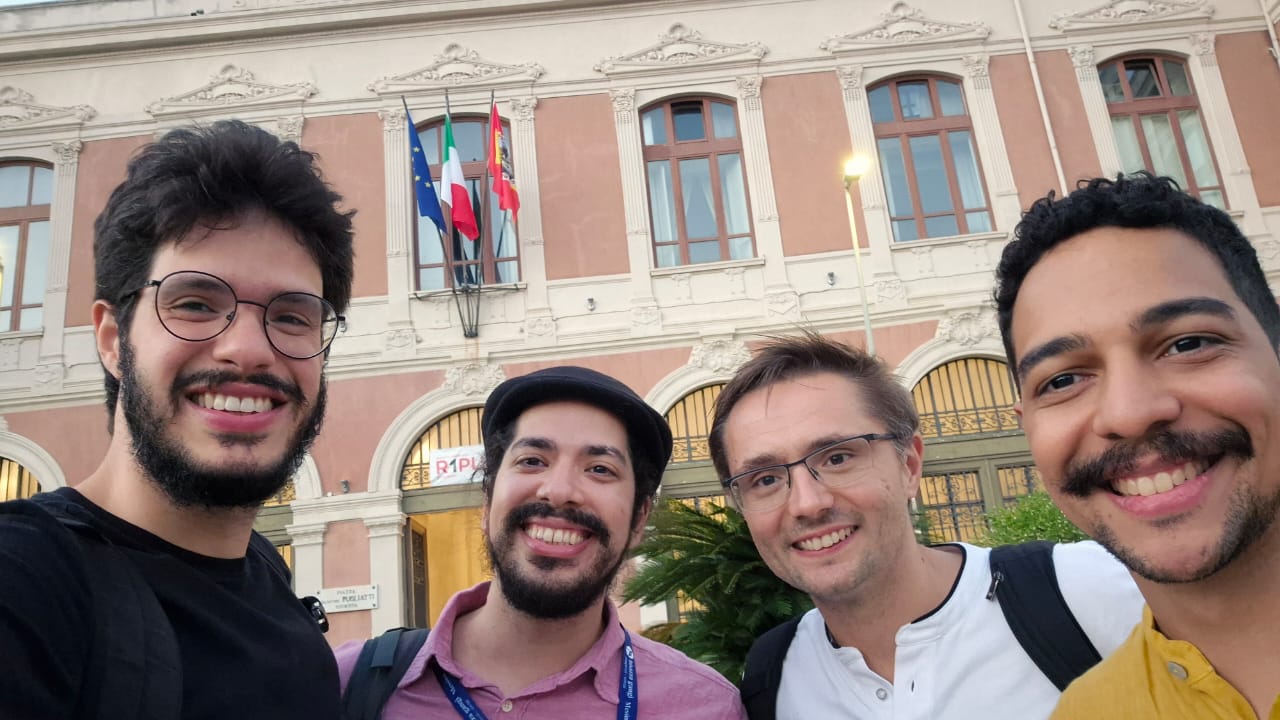
Messina, September 2026. -
Matheus' paper on vegetation patterns and plant-pollinator stability is out!
Matheus' project during his DAAD-CAPES internship in our group is finally published in PLOS Ecosystems' inaugural issue. In collaboration with David, the paper shows how self-organized vegetation patterns can support mutualism stability in harsher environmental conditions. Congrats Matheus and David!
-
Saira's internship is over
Saira is leaving us after finishing her HZDR Summer-program internship under David's supervision. In her time with us, she learned about vegetation pattern formation in drylands and worked on incorporating precipitation data into reaction-diffusion models describing this phenomenon.
-
Vinicius arrives in Görlitz
Vinicius is finally in Germany for the second year of his Master's studies, co-supervised by Ricardo and Rafael. He will stay with us for one year to conduct his thesis research on how range-resident movement shapes seed dispersal and emergent vegetation patterns in plant populations.
-
Anudeep's farewell
After three years in the group, Anudeep is taking off for new adventures. He was the first postdoc joining the group after we moved to CASUS, and he worked on developing new encounter theory for range-resident movement with directional persistence. Best of luck for your next endeavors, Anudeep!