Research
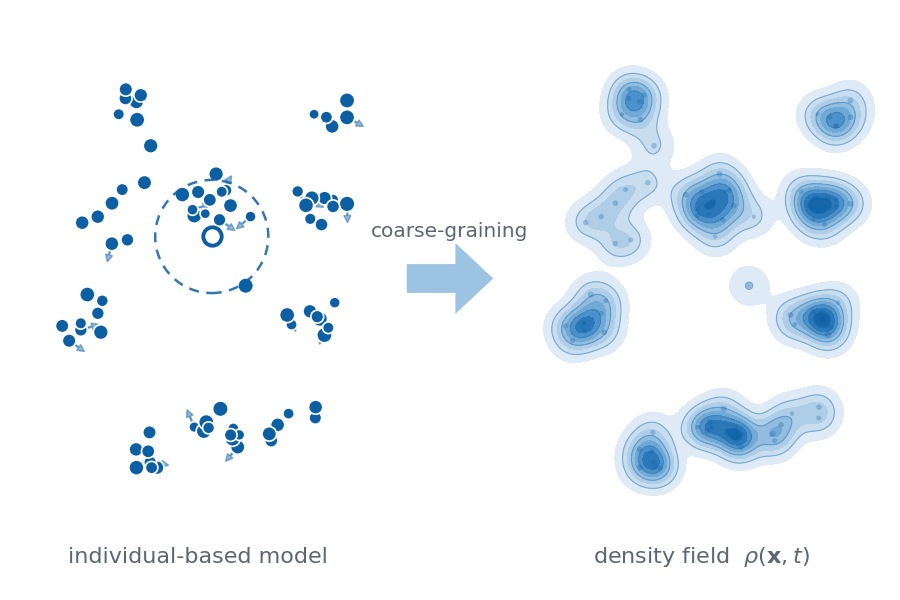
Our research focuses on understanding how organisms explore and respond to their local environment, and how these responses shape the outcome of larger-scale ecological processes, such as population abundances, species distributions, or ecosystem resilience. Our ultimate goal is to understand to what extent these larger-scale processes are emergent phenomena determined by organism-level behaviors, and to formalize this upscaling into unifying theoretical frameworks.
We work across a diversity of systems and scales, and develop both applied, system-specific and theoretical projects. In our projects, we combine mathematical modeling, intensive numerical simulations, and the analyses of various types of ecological data. We develop mathematical models validated against empirical data and then use those models to make new, testable predictions. We thus often work in close collaboration with experimentalists and field ecologists.
Some examples of specific projects are: